
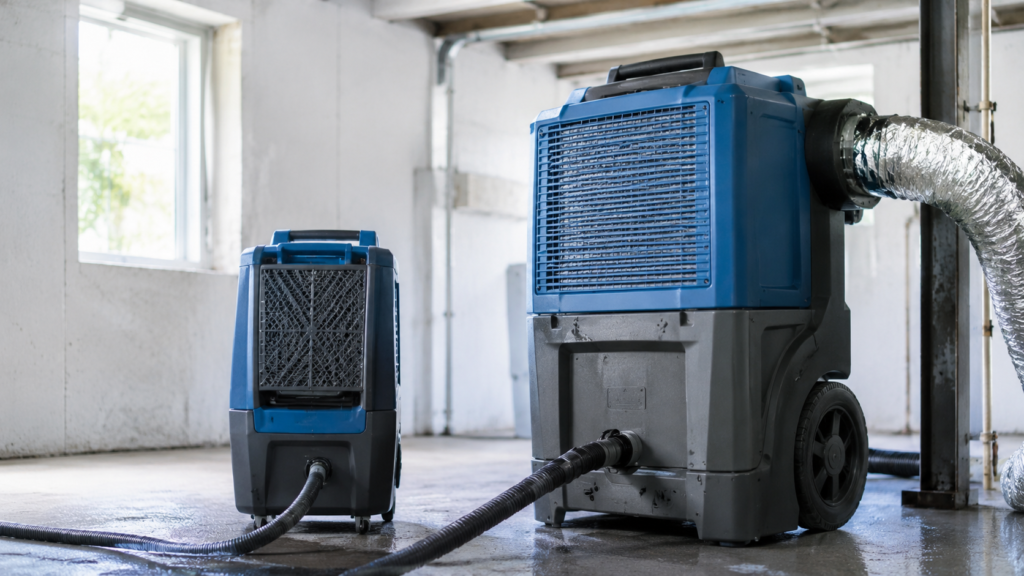
If you’ve started researching dehumidifier rentals after a flood, leak, or storm, you’ve probably noticed the options aren’t all the same. Rental companies and restoration providers usually split their equipment into two categories – commercial and industrial – and the difference isn’t just marketing language. It affects how fast your space dries out, how much you’ll pay, and whether you solve the problem or end up renting equipment twice.
This guide breaks down what actually separates the two categories, how to figure out which one fits your situation, and what happens if you guess wrong.
The Short Answer
Commercial dehumidifiers are built for enclosed residential and light-commercial spaces – a flooded basement, a water-damaged bedroom, a small office after a pipe burst. Industrial dehumidifiers are built for large-volume or high-humidity environments – commercial buildings, warehouses, multi-room floods, construction sites, or any job where standard equipment can’t pull moisture out fast enough to prevent mold.
The dividing line usually comes down to three things: square footage, how saturated the materials are, and how much time you have before mold becomes a real risk.
What “Commercial Grade” Actually Means
Commercial dehumidifiers are the mid-tier option between the small box units sold at hardware stores and true industrial equipment. They typically remove somewhere in the range of 70 to 150 pints of moisture per day, depending on the model, and are designed to run continuously in spaces up to a few thousand square feet.
This is the right category for most residential water damage situations: a flooded basement, a bathroom leak that got into the subfloor, a bedroom or living room after a roof leak. If you’re dealing with one or two affected rooms and the water intrusion was caught within the first day or so, commercial-grade equipment is usually sufficient to dry the space before mold has a chance to establish itself.
Restoration companies also use commercial units for smaller offices, retail spaces, and single-unit rental properties – anywhere the affected area is contained and the structural materials (drywall, subfloor, insulation) aren’t fully saturated throughout.
What Pushes a Job Into “Industrial” Territory
Industrial dehumidifiers are a different class of equipment entirely. They’re built to move significantly more air and pull substantially more moisture – often several hundred pints per day – and they’re designed to run in open, large-volume spaces where commercial units simply can’t keep up.
A few scenarios that typically call for industrial equipment:
- Large or open floor plans. Warehouses, gyms, retail floors, and open-concept commercial buildings have too much air volume for commercial units to dehumidify effectively.
- Multi-room or whole-floor flooding. If water traveled through several rooms or an entire level of a building, you need enough dehumidification capacity to treat all of it simultaneously – not room by room.
- Deep saturation. When water has soaked into concrete, thick insulation, or multiple layers of building material, drying takes longer and requires higher continuous moisture removal to keep pace with what’s still evaporating out of the materials.
- Time-sensitive commercial situations. Businesses that need to reopen quickly, or properties under an insurance clock, often rent industrial equipment specifically to compress the drying timeline, even in spaces that could technically be handled by commercial units on a longer schedule.
If you’re unsure which category your situation falls into, a moisture level assessment is the most reliable way to find out – it measures how much moisture is actually trapped in the structure, rather than relying on a guess based on square footage alone.
Why Renting the Wrong Category Costs You More
This is the part most people don’t think about until they’ve already rented the wrong unit. If you rent a commercial dehumidifier for an industrial-scale job, the equipment runs constantly but never catches up – moisture keeps re-accumulating faster than the unit can remove it. That means longer rental periods, higher total cost, and a longer window during which mold can start developing in wall cavities, subfloor, and insulation.
Go the other direction – renting industrial equipment for a small, contained space – and you’re paying a premium for capacity you don’t need, plus dealing with a bulkier unit that’s harder to place and louder to run in a residential setting.
The goal isn’t the biggest or most powerful unit available. It’s matching capacity to the actual moisture load, which depends on square footage, ceiling height, how wet the materials are, and ambient humidity.
Cost Differences Between Commercial and Industrial Rentals
Industrial units cost more to rent, both in daily rate and often in delivery and setup, since they’re heavier and sometimes require multiple units networked together (along with air movers) to treat a large space properly. Commercial units are less expensive per day but may need to run longer if they’re undersized for the job, which can close the cost gap more than people expect.
If you’re trying to estimate what you’ll actually pay before committing, it helps to look at rental pricing by scenario rather than by unit type alone – a breakdown of dehumidifier rental costs walks through how square footage, rental duration, and equipment tier affect the total price.
How Restoration Companies Decide
When a professional restoration crew assesses a water damage job, they’re not choosing equipment based on guesswork. They typically:
- Measure the affected square footage and ceiling height to estimate air volume.
- Test moisture content in walls, flooring, and other structural materials – not just visible surface water.
- Factor in ambient humidity and how long the space has already been wet.
- Calculate how many pints of moisture need to be removed per day to dry the space within a safe window (usually 3–5 days, before mold risk increases significantly).
That calculation is what determines whether one commercial unit will do the job, whether you need several networked together, or whether the space genuinely requires industrial-grade equipment. Renting on your own without this assessment means you’re estimating – and underestimating is the more common (and more expensive) mistake.
When to Bring in a Professional Instead of Renting Solo
DIY dehumidifier rental works fine for small, contained situations you caught early – a single wet room, minimal saturation, and a moisture reading that confirms the space is drying on schedule. Once you’re dealing with multiple rooms, saturated structural materials, or a commercial property, the math tends to favor bringing in a full equipment rental and drying service rather than piecing it together yourself. Professional setups combine dehumidification with strategically placed air movers and monitoring, which shortens the drying timeline far more than a rented unit running on its own.
Common Questions About Commercial and Industrial Dehumidifier Rental
Can I just rent two commercial units instead of one industrial unit?
Sometimes, but not always. Two commercial units can approximate the output of a smaller industrial unit in some cases, but they won’t move air the same way across a large open space. Industrial units are engineered for airflow and coverage, not just raw moisture removal, so doubling up on smaller equipment doesn’t always translate to even drying across a big room.
How do I know if my dehumidifier is undersized for the job?
The clearest sign is a moisture reading that isn’t dropping day over day. If you’re tracking humidity levels and the numbers plateau instead of trending down, the unit is likely running at capacity without making progress – a signal to move up to a larger or industrial-tier unit rather than just running the current one longer.
Do industrial dehumidifiers require special power setup?
Often, yes. Larger industrial units can draw more power than a standard residential outlet is rated for, and multi-unit setups sometimes need dedicated circuits or generator support on commercial job sites. This is worth confirming before rental day, since it can affect where the equipment can actually be placed.
Is it cheaper to buy instead of rent for a one-time flood?
For a single incident, renting is almost always more cost-effective than buying, especially for industrial-tier equipment, which is expensive to purchase and requires storage and maintenance between uses. Renting also means you’re not stuck estimating your own future needs – you rent exactly what this job requires.
Can I switch from a commercial to an industrial unit partway through a rental?
Yes, and it’s common. If daily moisture readings show the space isn’t drying on pace, most rental providers and restoration companies can upgrade the equipment mid-rental rather than starting over. This is one more reason ongoing moisture monitoring matters – it catches an undersized setup early instead of after several wasted rental days.
The Bottom Line
Commercial dehumidifiers handle the majority of residential and small-space water damage situations – contained rooms, moderate saturation, caught early. Industrial dehumidifiers exist for everything beyond that: large open spaces, multi-room or whole-floor flooding, deep material saturation, or situations where speed matters because of business downtime or insurance timelines.
The real decision point isn’t “which sounds more powerful” – it’s an honest read on square footage, how wet the materials actually are, and how much time you have before mold becomes a second problem on top of the water damage. When in doubt, get a moisture reading before you rent anything. Guessing low costs you in mold risk and repeat rentals; guessing high just costs you money you didn’t need to spend.
Leave a Reply