It’s 11:30 at night. You hear something dripping. You walk into the kitchen and find an inch of standing water spreading across the floor, soaking under the baseboards and creeping toward your living room. You grab your phone and type four words: water damage repair near me.
What comes up next matters more than most people realize. Choosing the wrong company in that moment – one that’s slow to respond, doesn’t know Fort Worth, or sends an undertrained crew – can turn a manageable problem into a costly disaster. Choosing a local, experienced water damage restoration team changes the outcome entirely.
Here’s why calling local is always the right move – and what makes Fort Worth’s water damage risks unique enough to demand it.
Speed Is the Difference Between Drying and Replacing
Water damage is a race against time. From the moment moisture enters your home, the clock starts. Within the first hour, water migrates through drywall, under flooring, and into wall cavities. Within 24 to 48 hours, wet building materials cross into mold territory. Within 72 hours, structural damage can become irreversible in high-saturation zones.
A national franchise with a regional dispatch center might quote you a two- to four-hour arrival window. A local Fort Worth water damage company can be at your door in 30 to 60 minutes. That hour – sometimes less – is the difference between extracting water and replacing flooring. It’s the difference between drying drywall and tearing it out.
When you search “water damage company near me” at midnight, the response time of whoever answers that call is quite literally the most important variable. Local teams don’t have to cross the metroplex. They’re already here.
Fort Worth Has Water Damage Risks National Companies Don’t Fully Understand
Not all water damage is the same, and not all markets are the same. Fort Worth and Tarrant County present a specific combination of climate, geography, and infrastructure that shapes how restoration work must be done.
North Texas storm season is relentless. Severe thunderstorms, flash flooding, hail, and high-wind events batter the area every spring and fall. The Trinity River floodplain runs through multiple Fort Worth neighborhoods, and areas like Riverside and Marine Creek experience flooding events that out-of-state crews have never encountered. Local teams know which streets flood first, which drainage systems back up, and how storm damage typically presents in this specific geography.
The climate makes drying harder. Fort Worth summers are hot and humid – a dangerous combination for water-damaged structures. High ambient humidity slows the evaporation rate inside a structure, which means dehumidification equipment must be sized and positioned differently than in drier climates. A crew using generic drying protocols in Fort Worth will under-dry a structure and leave behind the moisture mold needs to grow. According to the EPA’s guidelines on mold and moisture, indoor relative humidity should be kept below 60 percent to prevent mold growth – a benchmark that requires local knowledge to hit consistently in North Texas conditions.
Older homes hide damage in unexpected places. Neighborhoods like Haltom City, Morningside, and the Near Southside include homes built between the 1940s and 1970s with aging cast-iron plumbing, original wood subfloors, and uninsulated crawl spaces. Water behaves differently in these structures than in modern construction. A technician who has worked Fort Worth homes understands where water travels in a 1955 bungalow versus a 2015 new build in Keller or Trophy Club.
What a Local Fort Worth Water Damage Team Does Differently
When you call Water Damage Restoration Fort Worth, the process starts immediately – not after paperwork, not after a scheduling queue clears.
Thermal imaging and moisture mapping. Our technicians arrive with professional-grade thermal imaging cameras and moisture meters. Water that isn’t detected is water that creates mold. Our thermal imaging scan service finds hidden moisture behind walls, under flooring, and inside ceiling cavities before it becomes a mold problem.
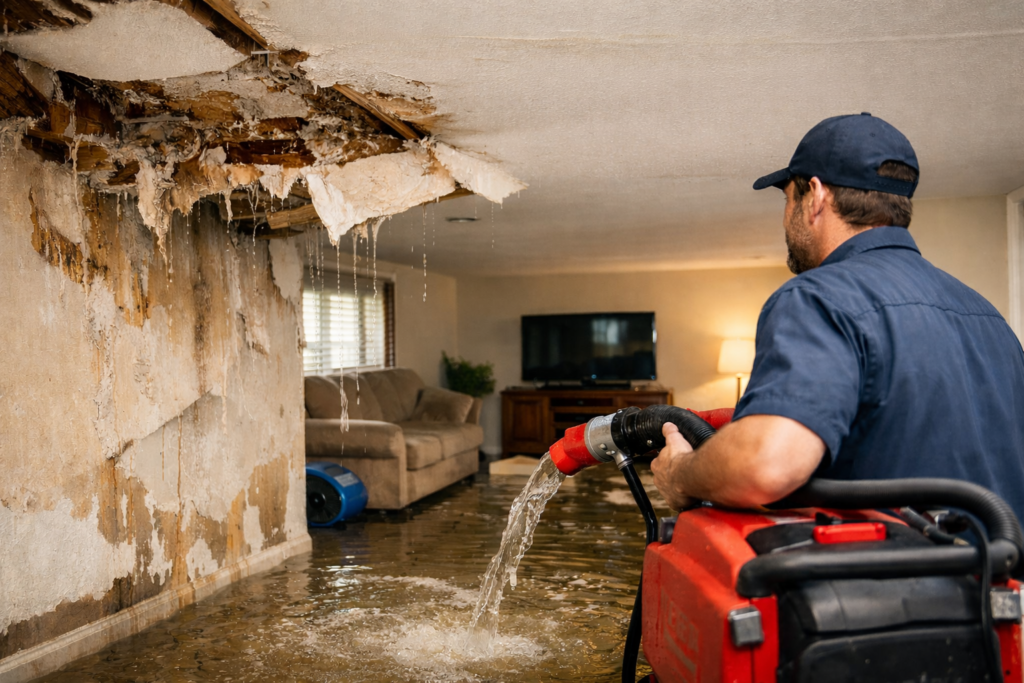
Rapid water extraction. We use truck-mounted extraction equipment that removes far more volume per hour than any consumer-grade wet vac. Fast extraction limits how deep water saturates structural materials – and directly reduces your total restoration cost.
Structural drying calibrated to Fort Worth conditions. Our emergency water removal service deploys commercial air movers and industrial dehumidifiers sized to your specific space and calibrated for North Texas humidity. We monitor moisture levels daily and adjust equipment placement as the structure dries. The typical drying phase runs three to five days – and we stay on it until every reading clears.
Mold prevention built into every job. After water extraction and drying, our technicians apply antimicrobial treatment to affected surfaces to suppress mold colonization. This step is especially critical in Fort Worth’s humid summer months, when mold can begin forming within 24 to 48 hours of a water event.
Insurance claim assistance. Dealing with insurance after water damage is stressful. Our team documents everything – moisture readings, photos, scope reports – in the format Texas insurance adjusters expect. Our insurance claim assistance service takes the paperwork burden off you so you can focus on getting your home back to normal.
Serving Every Corner of Fort Worth and Tarrant County
One of the real advantages of a locally rooted company is coverage. We don’t have territory gaps or franchise boundaries. Whether your home is in a dense urban neighborhood or a newer suburb outside Fort Worth, our team serves you directly.
Our service area covers all of Fort Worth and the surrounding communities, including Haslet, Westlake, Keller, Grapevine, Trophy Club, Justin, North Richland Hills, Haltom City, Bedford, Euless, Hurst, Southlake, Colleyville, Roanoke, Benbrook, and Weatherford. If you’re in Tarrant County or the immediate surrounding area, we can reach you fast.
The Local Accountability Factor
Here’s something that doesn’t show up in a Google search result but matters enormously: a local company has reputational stakes in every single job it takes. Every home we restore in Fort Worth is a neighbor, a referral, a review that the community reads. National franchises rotate crews and move on. A local team lives with its reputation every day.
When your restoration is complete and you have a question three weeks later about a damp smell or a moisture reading, you’re calling the same team that did the work. That continuity – the ability to call someone who actually knows your home – is something a national dispatch center structurally cannot provide.
Don’t Wait – Act in the First Hour
If water damage has already started in your home, the best time to call is right now. Every additional hour that passes means more saturation, more structural cost, and a higher risk of mold.
Search results for “water damage repair near me” and “water damage restoration near me” will show you options. Choose the one that’s actually local. Choose the team that knows Fort Worth streets, Fort Worth weather, and Fort Worth homes.
Call Water Damage Restoration Fort Worth now – 24/7 emergency response across all of Fort Worth and Tarrant County.
Leave a Reply