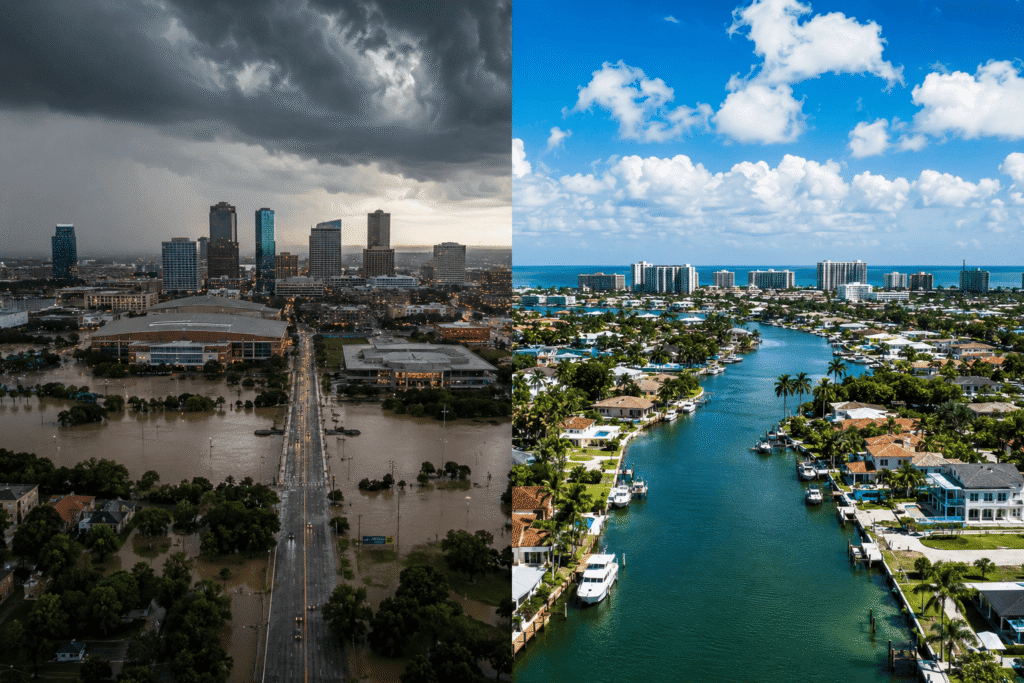
When water damage strikes, the restoration process isn’t one-size-fits-all. Where you live – your climate, soil type, building styles, and local weather patterns – plays a massive role in how water damage occurs, spreads, and how it must be addressed. Fort Worth, Texas, and coastal cities like Cape Coral, Florida, face very different water damage challenges. Understanding those differences can help homeowners and businesses make smarter decisions when disaster strikes.
THE GEOGRAPHY FACTOR: INLAND PLAINS VS. COASTAL WATERWAYS
Fort Worth sits in the heart of North Texas on the rolling plains of Tarrant County. The city experiences a semi-arid climate with hot summers, occasional severe storms, and periodic flash flooding from heavy rainfall on dry, compacted soil. Water doesn’t naturally drain away efficiently here – it pools fast and can push into foundations, crawlspaces, and basements with little warning.
Coastal cities, by contrast, are built on low-lying land often just feet above sea level. Cape Coral, Florida, for example, is a canal city with over 400 miles of waterways weaving through residential and commercial zones. When a storm hits, water doesn’t just fall from the sky – it surges in from multiple directions simultaneously. The soil is sandy and saturated, meaning it absorbs little and redirects water pressure directly into building foundations and slab structures.
This fundamental geographic difference shapes everything about how restoration teams respond and what equipment they need on the ground.
STORM TYPES: TORNADOES AND FLASH FLOODS VS. HURRICANES AND STORM SURGES
The primary water damage threats in Fort Worth come from sudden, intense thunderstorms, hailstorms, and occasional tornadoes. These events tend to be localized and fast-moving. A Fort Worth home might suffer a burst pipe from a sudden freeze in winter, a flooded basement after a rapid downpour, or roof damage from hail that allows rainwater intrusion. Our emergency flood damage repair team regularly handles these localized events with targeted rapid-response protocols.
In coastal cities, hurricane season from June through November creates an entirely different risk profile. These storms bring prolonged rainfall, storm surges, and sustained high winds that can inundate entire neighborhoods for days at a time. Restoration in coastal markets must account for saltwater contamination – an issue Fort Worth professionals rarely face. Saltwater accelerates metal corrosion, degrades drywall, and creates specific biohazard concerns that require specialized treatment beyond standard freshwater cleanup.
HUMIDITY AND MOLD: THE CRITICAL DIFFERENCE
One of the most significant contrasts between inland and coastal water damage restoration is the role of ambient humidity. Fort Worth’s average relative humidity sits between 50–65%, which is manageable. Once water is extracted and structural drying begins, the surrounding dry air actively helps pull moisture out of walls, subfloors, and cavities.
In coastal Florida cities, humidity regularly exceeds 80–90%, especially during summer and storm season. This creates a brutal environment for drying – the air itself is already saturated with moisture, which significantly slows evaporation and dramatically increases the risk of mold growth. Restoration companies in coastal areas like Cape Coral, FL deal with these extreme humidity conditions year-round and have developed specialized rapid-drying protocols using industrial-grade dehumidifiers running continuously for days or even weeks.
In Fort Worth, our mold remediation experts are well-equipped to handle mold risks, but the window of opportunity before mold sets in is slightly wider here than in coastal climates. Don’t be misled though-mold can begin developing within 24–48 hours anywhere, and immediate professional response remains critical regardless of location.
BUILDING STRUCTURES: PIER-AND-BEAM VS. SLAB FOUNDATIONS
Fort Worth’s housing stock is heavily built on pier-and-beam foundations and clay soils. When water enters a pier-and-beam home, it can accumulate in the crawlspace and wick upward into subfloors and structural supports over time. This makes moisture detection and inspection a critical first step problems invisible above ground can be severe below.
Coastal city homes are typically built on concrete slab foundations. While slab foundations eliminate the crawlspace concern, they create their own restoration challenges. Water can penetrate through slab cracks, become trapped under flooring materials, and create hidden moisture problems that are difficult to detect without thermal imaging and moisture meters.
Our structural drying solutions team uses advanced techniques specific to each structure type. Whether drying out a pier-and-beam crawlspace in Fairmount or handling subfloor moisture in a slab-built property in Southlake, the approach is always calibrated to the specific construction – not a generic one-size-fits-all solution.
WATER SOURCES: RAINWATER VS. SALTWATER CONTAMINATION
The type of water involved in damage incidents varies significantly between Fort Worth and coastal markets. Inland cities primarily deal with Category 1 (clean water from pipes or rain) and Category 2 (grey water from appliances or toilets). These categories, while serious, are generally more straightforward to remediate.
Coastal cities face a much higher frequency of Category 3 water damage – also called black water – particularly during hurricane events where storm surges push contaminated water from canals, bays, and the ocean into homes. Saltwater damage requires additional decontamination steps, and affected materials like drywall, insulation, and carpeting often cannot be salvaged.
Fort Worth homes aren’t immune to Category 3 incidents – sewage backups are a real concern – and our sewage cleanup services team is trained and equipped to handle biohazard-level water contamination safely and thoroughly.
INSURANCE CONSIDERATIONS: STANDARD POLICIES VS. FLOOD ZONES
Homeowners in Fort Worth typically carry standard homeowner’s insurance that covers many common water damage scenarios – burst pipes, roof leaks, appliance failures, and storm-related water intrusion. Flood damage from rising external water is generally excluded and requires a separate flood insurance policy.
In coastal cities, the insurance landscape is far more complex. FEMA flood zone designations in low-lying coastal areas require many homeowners to carry mandatory flood insurance through the National Flood Insurance Program (NFIP). Properties in high-risk zones pay significantly higher premiums, and even with flood coverage, navigating claims after a major storm event can be a lengthy, complicated process.
Regardless of your location, documenting damage thoroughly and working with a professional restoration company that understands insurance claim procedures is essential. Our emergency water removal process always includes detailed moisture mapping and photographic documentation specifically designed to support your insurance claim and help maximize your reimbursement.
RESPONSE TIME: WHY LOCAL EXPERTISE MATTERS IN FORT WORTH
Whether you’re in Fort Worth, Cape Coral, or any other city, one principle holds universally true: the faster a professional team responds to water damage, the less it costs and the better the outcome. Water spreads quickly – through walls, under floors, and into structural cavities within hours.
In Fort Worth, our team offers a 60-minute response guarantee because we know North Texas weather doesn’t follow a schedule. A sudden storm rolling through the Stockyards or a pipe burst in a Tanglewood home at 2 AM demands the same level of immediate, expert response. We’re a locally owned company staffed by IICRC-certified technicians who understand the specific soil conditions, building styles, and weather patterns of Tarrant County.
Coastal restoration companies face their own response challenges – often dealing with road flooding and access issues during storm events that can delay crews for hours. Fort Worth’s inland location means our teams can almost always reach you quickly, rain or shine.
FINAL THOUGHTS
Water damage is water damage – but the science, techniques, and urgency behind restoration varies considerably based on where you live. Fort Worth homeowners benefit from a drier baseline climate, less frequent saltwater contamination, and a slightly longer mold window than their coastal counterparts. But make no mistake: water damage here is still serious, still moves fast, and still demands immediate professional attention.
If you’re dealing with water damage in Fort Worth or anywhere in Tarrant County, call our team at (817) 755-5734 for immediate 24/7 emergency assistance. We’re local, we’re certified, and we’re ready to restore your property to its pre-loss condition – fast.
Leave a Reply